Nelson Valdemar LINKLATER
15.viii.1918 - 19.x.1997
He spent his final school year (1934) in the ‘Remove’. I only know two stories from his school days. His house-master Sidney Beckwith, then a young man, had recently married a pretty, young blonde wife who, some twenty years later, tried to teach me to paint. The Beckwith's bathroom was immediately below Dick's dormitory. Ever keen to expand their knowledge of comparative anatomy the occupants of Dick's dormitory decided to prise up a strategic floor board or two and make a suitable hole in the ceiling below, through which the contours of the comely wife could be observed as she went about her ablutions. The boards were loosened, the spy-hole made; all that was required was the sound of running water. Duly alerted by encouraging sounds that the show was on, the kneeling occupants of the dormitory jostled for position but unfortunately, in doing so, dislodged a chunk of plaster onto the occupant below, who turned out not to be the shapely wife, but the less-attractive bulk of her by now irate husband. They were all soundly thrashed. This presumably was before 1933 or would surely have merited a mention in his diary, where the only beating noted was that on 8 Oct 1934 (see above) “Got beaten by Brock...” etc.
I know of one other misdemeanour that won Dick the posterior attentions of Sidney B. Being bored one day in chapel and finding himself possessed of a razor blade he unpicked the seam on the back of the jacket of the boy slumped forward on the pew in front of him. The result was twofold; 1] when the congregation was invited to arise the boy in front arose as did his jacket; one half to the left, and one to the right; 2] my father received a well-deserved thrashing. [Information obtained direct from the offender.]
I can vouch for the quality of thrashings administered by ‘Sidney B.’ By the time of my schooling, he was head-master of the I.S.C. prep-school which had amalgamated with Haileybury. He had had some thirty years in which to improve his aim and perfect his technique from which I beneifitted on many occasions - “ this is for your own good...” etc. If this should create the impression that Sidney B was a slavering sadist, that would be incorrect; he was fair-minded and well liked. Bearing in mind that to a ten- or twelve-year old, anyone over 15 is old and anyone over 20 positively antiquated, by the time Sidney B was called upon to administer justice to my nethers ca. 1960, he must have had more than a touch of the sear and yellow about him, and probably retired shortly after I left the school. However, the nerve endings in my buttocks carry the memory to this day of the vigour of his strokes. Were they diminished by age, then those received by my father must have been truly resounding.
I wonder if the ritual was the same in my father's day. Malefactors in my time were summoned by Beckwith to give an account of themselves before sentencing. If it was to be a beating, this was always received in pyjamas just before lights-out with the guilty party bent over the foot of his bed, the other occupants neatly tucked up in theirs. Justice was thus done and seen to be done by the other occupants of the dormitory. The minute Beckwith withdrew the victim lowered his pyjama trousers and a discussion ensued as to the quality of the caning; the spacing and severity of strokes delivered being analysed by young cognoscenti with the aplomb of old farts discussing the club's port, cricket scores or whatever it is that old farts discuss. There was cause for self-congratulation if the spacing was wide and the welts less than bloody, but no kudos to be gained thereby; that required closely spaced strokes with well-risen weals, and preferably some blood, born with stoicism. I don't remember any beating being considered ‘deserved’; transgressions meriting the cane were usually against the régime rather than one's peers. By the same token, beatings were rarely considered unfair. But I digress.
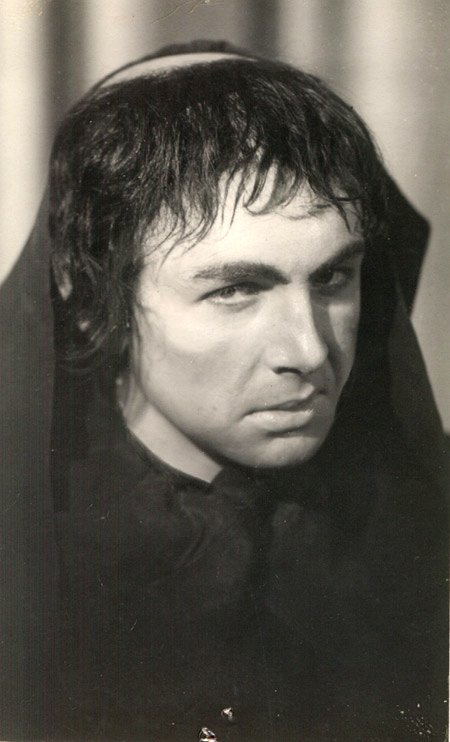 I left school to work as a clerk in a Stockbroker's office
(Waithman, Donegan and Co., 11 Copthall Court, London, E.C.) and
was there for about a year. Finding this job uncongenial, and the ultimate
prospect dull, and being very anxious to get into the theatre, I became
a student at the R.A.D.A.
I left school to work as a clerk in a Stockbroker's office
(Waithman, Donegan and Co., 11 Copthall Court, London, E.C.) and
was there for about a year. Finding this job uncongenial, and the ultimate
prospect dull, and being very anxious to get into the theatre, I became
a student at the R.A.D.A.
It was obviously unnecessary to dwell on another job preceeding that with Waithman, Donegan and Co., that of a bookie's runner. Apparently one of his first tasks was to deliver something to a certain address - winnings, a hot tip whatever. As his tentative, preliminary rings failed to arouse anyone, Dick applied himself to the knocker, only to have the door suddenly flung open from within by a scantilly clad woman in full tirade; "ooo the 'ell d'yer fink ye'r? Makin' all that bloomin' racket. 'snuff to raise the bloomin' dead. Andgerlate. Well don't just bleddin' staynd there gawpin' fer all me naybers. Get yer arse up them stairs!" So up them stairs he got his arse and only with the greatest difficulty managed to get through to the lady that he was a mere delivery boy, not a customer seeking a bit of a Beckwith. With work experience like this, plus his scholastic record, Dick was a natural for the Stock Exchange. Common sense finally prevailed and he auditioned successfully for R.A.D.A.
At the R.A.D.A. I was awarded the Irene Vanburgh Prize in my third term, and a certificate of Merit in my fourth term when a finalist. (Diplomas were not awarded to students leaving at the end of a Summer Term).
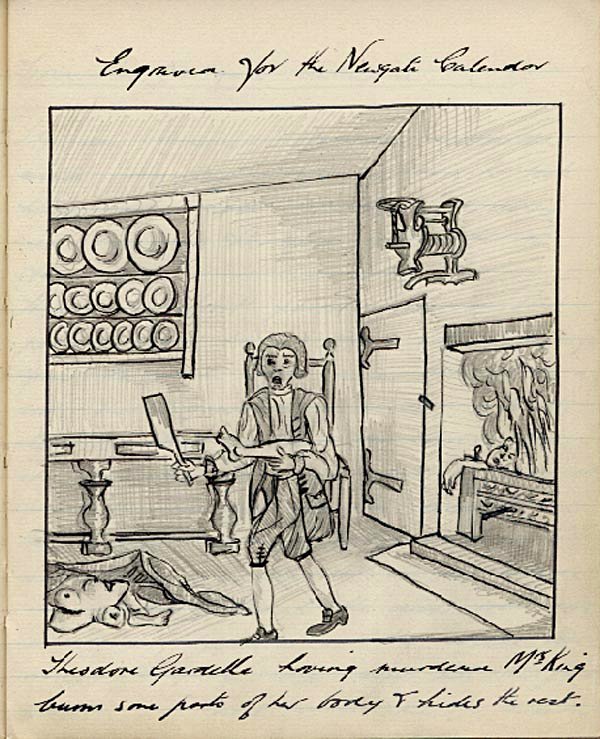 While at R.A.D.A. he also studied art which
remained a life-long interest and hobby. This grizzly picture is the outcome
of research Dick did into “The Murder of Mrs Anne King by Theodore
Gardelle in Leicester Fields, London, 1761” - as Dick entitled the
notebook into which he transcribed information from a dozen or so books
which he studied in the British Museum Reading Room between 24th October
and 29th November 1938. I can be so precise because he preserved all the
library slips! Just what it was that Dick found so absorbing about this
case I do not know, unless it was the bizarre manner in which Theodore Gardelle
tried to kill himself after his arrest. I think Dick may have had a play
in mind, although I know of no sketches etc, but only the one volume of
copious notes from which the above illustration is taken. On being thwarted
in his attempt to take poison (arsenic or opium depending on whose version
you believe) he tried to commit suicide by swallowing two dozen ha'pennies.
I remember Dick telling me of this in my youth. Jack Ketch finished the
job in due course. Like many of us, Dick read about crime - both fact and
fiction. He recorded on 19 June 1934; I bought a book - Murders
and Trials - for half a crown - one of many such acquisitions.
While at R.A.D.A. he also studied art which
remained a life-long interest and hobby. This grizzly picture is the outcome
of research Dick did into “The Murder of Mrs Anne King by Theodore
Gardelle in Leicester Fields, London, 1761” - as Dick entitled the
notebook into which he transcribed information from a dozen or so books
which he studied in the British Museum Reading Room between 24th October
and 29th November 1938. I can be so precise because he preserved all the
library slips! Just what it was that Dick found so absorbing about this
case I do not know, unless it was the bizarre manner in which Theodore Gardelle
tried to kill himself after his arrest. I think Dick may have had a play
in mind, although I know of no sketches etc, but only the one volume of
copious notes from which the above illustration is taken. On being thwarted
in his attempt to take poison (arsenic or opium depending on whose version
you believe) he tried to commit suicide by swallowing two dozen ha'pennies.
I remember Dick telling me of this in my youth. Jack Ketch finished the
job in due course. Like many of us, Dick read about crime - both fact and
fiction. He recorded on 19 June 1934; I bought a book - Murders
and Trials - for half a crown - one of many such acquisitions.
On leaving the R.A.D.A I joined H.V. Neilson's Frank Benson Shakespeare Company, touring in an odd assortment of parts in a repertoire of nine plays. During the Christmas break I played in a Pantomime at the People's Palace.
In the Autumn of 1938 I was at Miss Thorburn's Theatre in Uckfield, Sussex - but this was an ill-fated season, upset by the Munich crisis etc., and I joined Eric Blankney's Academy Players, produced by Wallace Evenett. This was a fit-up Company touring round schools and the smaller towns with scenes from Shakespeare and Shaw's ‘Arms and the Man’.
There is an undated address book which must be from around 1938 and which may give some indication of how far afield Dick's touring took him, as a number of the addresses are indicated as “digs”. The places include London, Uckfield, Bromley, Westcliff-on-Sea, Clifton (Bristol), Exeter and Torquay.
He made his stage debut in, I think, Sheridan's ‘School For Scandal’, though what part I am unsure. The only other annecdote of Dick's stage career concerned a part in which he was onstage with a basket of figs or fruit. On the first night, word-perfect and with a well-rehearsed dramatic flourish he announced “I take my fruit and go!” or words to that effect, and stage direction that he do just that. Unbeknownst to Dick, some “whoreson knave” in the cast had nailed his basket to the floor! Very childish - like putting the Office stapler in jelly.
The following spring I was offered the job of Assistant Manager (front of house) to J.E. Masterton, for the Wilson Barrett and Esmond Knight Company at the King's Theatre, Hammersmith, and was there until mobilized into the Royal Navy in August 1939, when I was just 21.
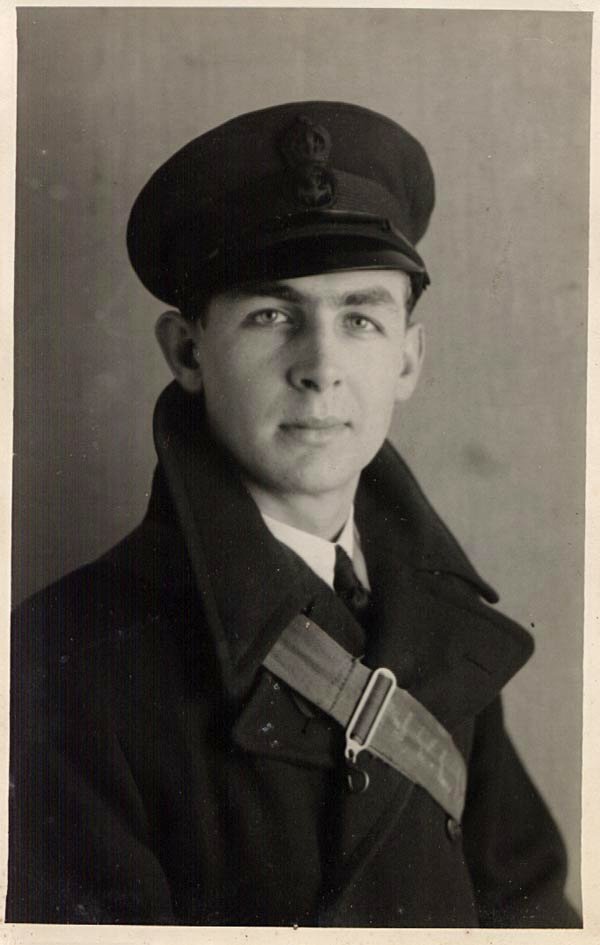 The photograph at right was taken about the time Dick enlisted. The reverse
is inscribed in his father's handwriting; “3rd
Sept. 1938 War declared. 3rd March left home to join H.M.S.‘Resolution’.”
Dick always maintained that he was the first casualty of the War. He was
making merry somewhere at the thought of killing Jerry when, within five
minutes of War being declared he was coshed in a public lavatory and robbed
of ten bob. I have it in the back of my mind that the scene of the crime
was the public lavatories in the Guildhall in Windsor, but may have this
wrong, so don't put a plaque up yet. [Ten bob was slang
for ten shillings, and ten shillings was 'old money' for fifty pence. The
only beer I knew Dick to drink was ‘bitter’. Depending on his
preferred tipple at the time, whether for ‘ordinary’ or ‘best’
etc., 10/- would have bought 15 to 20 pints, more than enough to ensure
approaching war in the right frame of mind. (In 1939, porter and best mild
were 6d a pint; ordinary bitter 7p a pint; best bitter and stout 8d a pint.)
Dick was a very modest drinker; I only ever knew him to drink the occasional
half pint or glass of wine. God knows where I get it from!]
The photograph at right was taken about the time Dick enlisted. The reverse
is inscribed in his father's handwriting; “3rd
Sept. 1938 War declared. 3rd March left home to join H.M.S.‘Resolution’.”
Dick always maintained that he was the first casualty of the War. He was
making merry somewhere at the thought of killing Jerry when, within five
minutes of War being declared he was coshed in a public lavatory and robbed
of ten bob. I have it in the back of my mind that the scene of the crime
was the public lavatories in the Guildhall in Windsor, but may have this
wrong, so don't put a plaque up yet. [Ten bob was slang
for ten shillings, and ten shillings was 'old money' for fifty pence. The
only beer I knew Dick to drink was ‘bitter’. Depending on his
preferred tipple at the time, whether for ‘ordinary’ or ‘best’
etc., 10/- would have bought 15 to 20 pints, more than enough to ensure
approaching war in the right frame of mind. (In 1939, porter and best mild
were 6d a pint; ordinary bitter 7p a pint; best bitter and stout 8d a pint.)
Dick was a very modest drinker; I only ever knew him to drink the occasional
half pint or glass of wine. God knows where I get it from!]
In spite of coming off second best in the opening campaign of the war, Dick was only to suffer one other minor injury - and that as a result of ‘friendly fire’. He contrived to step in front of a small-arms instructor just as the instructor went ‘live’. Dick received the bullet in the leg but it was pronounced inoperable as its removal was likely to cause more harm than good. He showed no ill effects and it certainly never affected his walking, which was always at a tremendously brisk rate. Of which more anon. I believe the nearest he came to any major action was on the fringes of the Battle of Narvik. He was a gunnery spotter; that is to say he had to observe the trajectories of shells and, relative to their intended targets say “up a bit”, “left a bit” etc. Apart from serving on the Resolution there is a photo of HMS Zambesi among his pictures and on which he served, as also HMS Baldur II. But I probably owe my name to the fact that for a while Leading Writer Linklater C/SR 8497 was to be found in Mess 2M of Duncan Block at the R.N. Barracks, Chatham.
I served as a rating until August 1941; a leading Hand until March 1943, and a Petty Officer until commissioned as a Paymaster Sub Lieutenant in July 1943. In the following year I was awarded twelve months accelerated promotion, following special commendation by the C-in-C, Plymouth, and was made a Lieutenant (S).
When in Iceland 1942/43 I used to assist in the short Forces Broadcasts relayed from Reykjavik. These were run by a Flight Lieutenant Thornton, R.A.F. who had been a B.B.C. man before the war. They mostly consisted of variety and orchestral programmes made up from gramaphone records, but we also read news summaries and so on. I also helped to run gramaphone record concerts for the Y.M.C.A., and later, when I was in Cornwall, in 1944, I ran similar weekly concerts.
Among Dick's letters was preserved a typed copy of ‘Four Excerpts’ from ‘R.N.V.R. - Twenty Years’. I don't know who the author was or what this was, whether a book, article etc. but the excerpts relate to the author's time stationed in Iceland and Falmouth.
I was in charge of the Outer Office and answerable to the Admiral's Secretary, Paymaster Lieutenant Commander Ronald Owen R.N. The desk next to mine was occupied by Leading Writer N.V. Linklater, known then as "Links" and next to him sat Leading Writer Neil W Nicholson, an employee of Christian Salvesen & Co. Ltd. He had some knowledge of Scandinavian languages and, exceptionally, may have been in his second year in Iceland. Many evenings working late provided opportunity to get to know ratings with whom one worked resulting in two lasting friendships. Leading Writer Linklater had been through R.A.D.A. and had been Assistant Stage manager for the Wilson Barrett Repertory Company. Owen and I agreed that he was wasting his talents and encouraged him to apply for a Commission in aid of which he was promoted to Acting Petty Officer Writer and, in due course, went back to the U.K., appeared before a Board and was commissioned as a paymaster Sub. Lieutenant R.N.V.R.
When I arrived at Falmouth I found a minimal staff in the Admiral's Office. This was understandable because naval activity had not been great. I had a good relationship with the office of the Paymaster Director-General in Admiralty and was able to persuade them that there was an urgent requirement for a Secretary for the Maintenance Captain, who doubled as Commanding Officer, H.M.S.Forte. This was filled by Paymaster Sub. Lieutenant Anthony Creery-Hill R.N.V.R., who became a friend and remains so. Another urgent requirement was for a Confidential Book Officer. This was filled by Paymaster Sub. Lieutenant N.V. (Dick) Linklater R.N.V.R.
I was living in rooms a short distance from the office and Dick joined me thus furthering our friendship. His work load was considerable as he was responsible for issuing Confidential Books to both R.N. and U.S.N. Ships and Establishments throughout the Command. Also serving on the Admiral's Staff was Second Officer Peggy Boissard W.R.N.S. of a talented family, who hailed from Guatemala where her Father had a plantation. They fell in love and were married on 31st July 1944. I was thus left on my own and moved to Church Farm, near Budock Water 2 miles approx. distant from Falmouth. Living was good with plenty of eggs, Cornish Cream etc. and kind hosts. I bicycled up and down steep hills, partly on church paths, but when the Admiral and I were working late, he insisted that I be taken back by service transport, a procedure which worried the Maintenance Captain to no avail.
A notice in the paper announced that “on 31 July 1944 at the Church of St Stephen and St Mawnon, Cornwall, Sub-Lt N.V. Linklater R.N.V.R... [married] ...Margaret Lilian Boissard...” The church is in a village called Mawnon Smith a few miles south-west of Falmouth.
In course of running down the Falmouth Command after VE Day, Dick Linklater reported that all the Confidential Books from the Coastal Forces Base had been returned with no corrections inserted. I sent a signal to the Commanding Officer, Commander Halliwell R.C.N. Retd. to recover the books and correct them. His reaction was to tell me that he would not stand for such a signal sent by me! I replied that the signal came from the Admiral. As he is insisted that I was the originator, I said he was correct and that the Admiral would see him at 2 p.m. so that he could state his complaint. As I expected, the Admiral said “Well done”. Shortly after, the Commander called to say that he had thought better of his complaint and did not wish to see the Admiral who was not surprised when I told him.
I continued to serve as a Lieutenant (S) until released in April 1946, and at the end of my leave in June of that year I got the job of Films Officer to the Army Kinema Corporation, Northern District, here in York. [They were living at ‘Tranby Croft’, The Avenue, Clifton, York.] My appointment now is as District Documentary Films Manager, and my salary is £525 per annum. It is an administrative post.
I joined this corporation on the advice and recommendation of Mr Masterton, who had been the General Manager of King's Theatre, and who is the District Manager of the Army Kinema Corporation here. He then held out promise of a new theatre venture, which has, however, fallen through; and I wish to return to work connected with the theatre and the other arts.
I was married in 1944, have a son of 2½ and my wife is having another baby in April. Me!
Which is where we came in with Dick soliciting employment with the Arts Council early in 1948. All of which bore fruit because on 10th Feb 1948 the General Secretary of the Arts Council of Great Britain wrote “I am authorised to offer you on behalf of the Council a position as Assistant Regional Director in Nottingham. The Council offers, in the first case, a contract for one year at a salary of £450, to which would be added an expense allowance of £156...You woud be required to take up your duties in Nottingham on the 1st April or shortly after that date...”
Dick's letter of acceptance dated 11 Feb 1948 concluded; “I note that I will be required to take up my new duties on the 1st April or shortly after. May I please ask a concession here, that, if convenient to the Council, the commencing date be a few days after the 1st. I will be required to work-out my present job until the 31st March, and as my wife is expecting her baby on the 8th April [I was 2 days late] I will appreciate some time between appointments.” Concession presumably conceded.
Duncan Linklater © 2025