Janet IRVINE, Postmistress
19.viii.1825 - 17.ix.1902
Things do not appear to have improved much after this inauspicious start. Fast forward to 1902 when Janet Irvine's death is recorded as occurring on 17th September as follows.
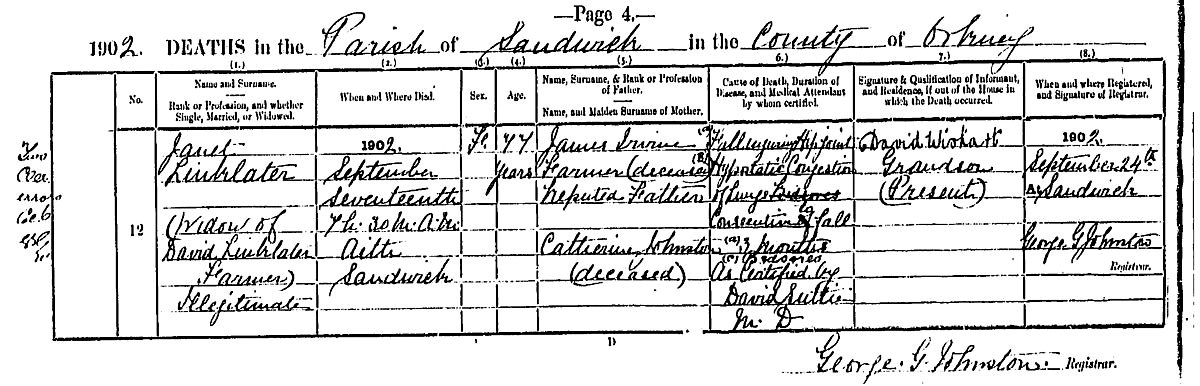 In case you can't make it out, at the bottom of the first column,
below her married name, Janet Linklater, is this throw-away line; (Widow
of David Linklater, Farmer) Illegitimate No parentheses there to
cover the stigma of being ‘vnlauchfully gotten outwith the bande
of mariage’. Born to sustain thy mother's shame,
In case you can't make it out, at the bottom of the first column,
below her married name, Janet Linklater, is this throw-away line; (Widow
of David Linklater, Farmer) Illegitimate No parentheses there to
cover the stigma of being ‘vnlauchfully gotten outwith the bande
of mariage’. Born to sustain thy mother's shame,
A hapless fate, a bastard's name.
Lady Bothwell's Lament The question therefore
is; why was Janet's birth never legitimised? The key to answering
that lies in identifying exactly who her mother and father were and what
their circumstances.
The first census following Janet’s birth should have been held in 1831 but sadly there was no official census taken till 1841. While there was no official census in 1831, the Rev. C. Clouston undertook a private census in 1833 or ‘34 (OA D3/357), in which he recorded for Aith: Thomas Irvine and his wife Sibby; James Irvine and his wife Margaret Corigal with ‘their’ daughter Janet, and 3 others; Samuel Rolland and Janat Moar, servants; and Thomas Inkster, his wife, and their children Isabela, David, Mary and George.
However there was a census shortly before Janet’s birth in 1821 from which the records for Sandwick and Stromness survive. In the parish of Sandwick there are 3 records of a James Irvine. [There were no Irvings recorded till 1841 and then they were all originally Irvines who chose to become Irvings – for a while at any rate – our James being the one going for the g spot.] But in 1821 there were records for James Irvine as follows;
| 10/13 | at Skaebreck, North Dyke, an 18 year old, apparently unmarried |
| 13/21 | at Quarrybank, Housegarth, a 35 year old, married farmer |
| 16/6 | at Eath, Aithstown, a 19 year old, unmarried, strawplaiter. |
| At the same address; Thomas Irvine, 60, farmer; his wife Sibella, née Baikie, 50; | |
| another Sibella, aged 18; Peter aged 15; and William Belly, aged 10, a servant. |
[O.S. refs: Skaebreck 238 215; Quarrybank ca. 251 201; Eath 250 178]
There is only 1 record of a Catherine Johnston in the parish of Sandwick in 1821;
| 11/9 | at Vola, Skebra, a 7 year old attending school |
For this Catherine at Vola to have been my great-great-great-grandmother would mean her being led down the primrose path of dalliance aged only 11 – pretty unlikely one would hope. Which suggests that on the day the census was taken Janet’s mother-to-be was not within the parish of Sandwick whereas her probable father almost certainly was. However, the Stromness 1821 census also has a Catherine Johnston;
| 1/375 : 251 | Catherine Johnston, 25, Strawplaiting |
She is the only person recorded for that property, with no indication of parents or siblings, nor any other Johnstons in contiguous records, which tend to reflect adjacent properties. The nearest other Johnston is Betty, in the Fraser household 1/378 : 252. Betty was also recorded as 25 and a strawplaiter. They may have been unrelated; they may have been twins; or their ages could have been rounded up or down as was common in early censuses. I am not sure what property exactly is indicated by 1/375:251 other than that it is within rather than outwith the town itself. More work!
So, nota bene; at this stage, we have two people about the right age both of whom are straw-plaiters. Straw-plaiting was big business in Orkney for several decades. By 1814, 1,200 to 1,400 people, mostly women, were involved in the work in Orkney. The standard whack was one penny a yard and a woman could earn 10d to 1/6 a day. [Price of a loaf?] Come 1834, according to one of his account books, Robert Mainland of Kirkwall apparently employed 1,707 people. Of these, 628 were employed in Kirkwall, where the streets were clearly paved with gold. The rest were employed elsewhere in Mainland; 33 in Stromness for example, as well as on several other islands. There were other manufacturers based in Kirkwall (e.g. Ramsay), Stromness (e.g. Heddle) and elsewhere, but from starting out as a factory based manufactory, straw-plaiting evolved into a cottage industry with many women working at home or in quasi-communal workshops. “Just as people gathered together for spinning and weaving, so plaiting also became integrated into the community. Townships often set aside a chaamer for plaiting, so that the work could be done cheerfully in company.” [Fenton, ‘The Northern Isles’ 1978]. They commonly worked 30 or 40 to a room.
Ubi mel ibi apes so small wonder that such places were also the haunt of men. That alone could account for the presence of my g-g-g-grandfather but the unmarried, nineteen-year old James Irvine recorded living at Eath, Aithstown in the Sandwick 1821 census was himself a straw-plaiter. Of the 70 odd straw-plaiters recorded in Sandwick in 1821 only 4 were male, and three of those from one household [13/23] whose head was Ann Linklater! although the surname of these three straw-plaiters was Brass. The only other male straw-plaiter was James Irvine. Among the more ‘manly’ occupations were shoemaker, blacksmith, carpenter or labourer, but the figures are somewhat misleading. Apart from heads of households who were farmers, there were comparatively few recorded males between the ages of 15 and 50. Those that are recorded often have no given occupation. Those ‘missing’ are presumed to have been away at the Davis Straight whaling or Hudson’s Bay.
Duncan Linklater © 2025