Janet IRVINE, Postmistress
19.viii.1825 - 17.ix.1902
A more important circumstance favouring Orcadians was, as noted by Troup and Eunson, that they were “very poor and hence starting wages, rising with each re-enlistment…seemed princely.” In addition they were “accustomed to great hardship and thus could endure the rigours of the Arctic.” [Ib.] By the 1790s three-quarters of the Hudson Bay Company’s employees were recruited from Orkney, several rising to senior positions.
“The main competitor of the Company was the merchant navy and the navy itself during times of war.” [Fenton] Nearly 1¼ per cent of the Navy during the War of the American Revolution was recruited or pressed in Orkney, some 1,200 men in all. [The total population in Orkney in 1821 was about 27,000. 1,200 men must have been at least ten per cent of the male population of working age.] The years immediately preceding the 1821 Census were preoccupied with ridding Europe of Napoleon. What proportion of the Navy then was composed of Orcadians I have yet to discover, but it must have been significant. “It has…been estimated that by the time of Trafalgar there were approximately three thousand Shetlanders in the Navy...This figure…represents…half the adult male population of the islands.” [The People of Orkney, Barry 1986].
One way and another, on 28 May 1821 [check date] any number of able bodied men might have been absent from home in Orkney, but not James Irvine, who, unlike many of the other males of working age for whom no occupation is recorded, gave as his occupation straw-plaiter.
“Sandwick was a kind of straw-plaiting centre. Here winter plaiting was complemented by summer work, reaping and preparing the 9 acres of rye that provided the raw material.” [Fenton] At its peak the industry was worth about £30,000 a year and employed a staggering 7,000 women which must have been nearly half of all the women in Orkney. The population of the whole of Orkney in 1851 was around 31,000. Say 10% were children. [Up to the age of 14 children were commonly recorded as ‘scholars’ thereafter they worked; they often worked much younger e.g. “William Belly, aged 10, a servant” as noted above.] Half of the remainder would have been male, leaving a total pool of around 14,000 women. As an industry, straw-plaiting came to an end in Orkney in the 1870s.
The bulk of the work was making straw boaters which, at the time, were very fashionable – until that is, according to popular legend, Queen Victoria put one on her dog and found the effect so hilarious that the demimonde could not face comparison with the Queen’s pug.
Johnston was not an uncommon name in Orkney; in Sandwick in 1821 there are 35 recorded compared with 39 Linklater and 36 Irvine. Figures for the parish of Stromness in 1821 are; Johnston 31, Linklater 60, Irvine 108 - again, no Irving. So, Catherine Johnston and James Irvine, whoever exactly they were, get it together probably some time in November 1824, when there are an accommodating seventeen hours of darkness in Orkney.
You may do in the dark
What the day doth forbid;
Fear not the dogs that bark,
Night will have all hid. [Thomas
Campion: Hark All You Ladies]
They should have harkened less to Campion and more to Ephesians; “have no fellowship with the unfruitful works of darkness, but rather reprove them.” Because, according to Corinthians: Be not deceived: neither fornicators, nor idolaters, nor adulterers, nor effeminate, nor abusers of themselves with mankind, nor thieves, nor covetous, nor drunkards, nor revilers, nor extortioners, shall inherit the kingdom of God. [That’s me stuffed then.] Pithier, from a little later, is: “Flee fornication!” Must have been a bad lot, those Corinthians.
Nine months later, on 19 August 1825 to be precise, Catherine gave birth to Janet. (It is possible that Catherine had already born James “a son” in 1819. Just that – “a son, 1819”, and the correct year of Janet’s birth, are noted on the ‘Irvines of Croval’ spreadsheet q.v.) Apart from being recorded in the baptismal register as noted above, Janet does not resurface officially until 1841 apart from the rather mysterious reference to James Irvine and his wife Margaret Corigal with ‘their’ daughter Janet in Rev. C. Clouston’s 1831 census as noted above. But in the 1841 census Janet herself is recorded, in the first of seven censuses, as living at Aith in Sandwick. The same census also records residents named James Irvine at;
| 1/6 | North Dyke, 35, farmer, married to Catherin (sic) aged 30 |
| 1/9 | North Dyke, 50, farmer, married to Marrian also 50 |
| 3/24 | at Mount, a 1 year old. |
None of these old die-hard Irvine spellers is our man who, for some reason, in the 1841 census, took to spelling his name with a g rather than an e. Thus we have;
| 3/57 | James Irving, Chamber of Aith, 40, agricultural labourer. Married to: |
| Margaret Irving aged 35; another James Irving, 5; Matilda Irving, 4; | |
| and Jamima Irving aged 1. |
Living in an adjacent property were Janet with her presumed aunt Sibella, sister to the above James, and their mother, also Sibella who, most tellingly, all follow James’ g-shift and are Irvings to a man – except of course there isn’t one because he’s elsewhere;
| 3/56 | East Aith; Sibella Irving aged 75; Sibella Irving aged 35; |
| Janet Irving, 15; John Tait, 12, herd. |
The most likely link is that provided by the two Sibellas suggesting that the James Irvine recorded in 1821 [16/6] living with them at Eath, Aithstown was most likely to have been my great-great-great-grandfather, and the older Sibella Janet’s grandmother, the younger Sibella her aunt. If true it also means I acquire two new great-great-great-great-grandparents, Thomas Irvine and his wife Sibella, née Baikie. Hello! [Another Baikie, Marion, aged 48, was recorded married to John Johnston in the Sandwick 1821 census and living at East House, Tenstown. Living with them was, among others, Jannet Johnston, yet another strawplaiter – 4/4.]
| 4/4 | East House, Tenstown: John Johnston, 59, farmer; Marion Johnston née Baikie, 48; |
| Jannet Johnston, 27, strawplaiter; John Johnston, 22, showmaker; | |
| Isabella Johnston, 11; William Johnston, 5. |
Let’s have a picture.
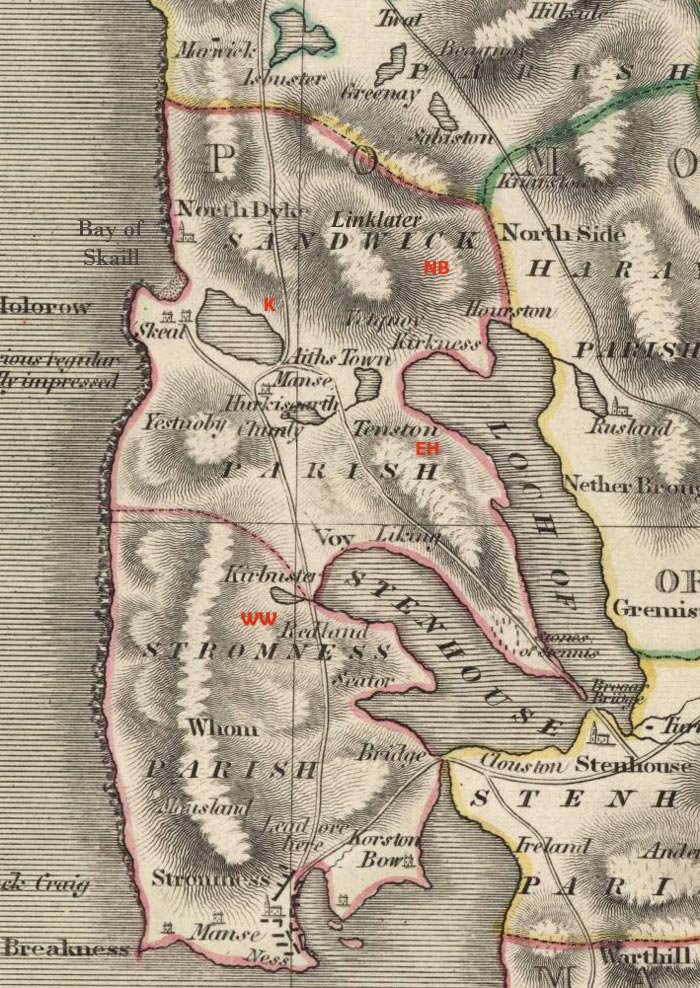 The collection of buildings referred to variously as Aith, East Aith, Eath,
Aith Post Office, Chamber of Aith etc. cluster around the road junction
at the eastern end of the Loch of Skaill and marked on the map at right
as Aiths Town. Aficionados of Orkney maps might be amazed at the accuracy
of this map, based, as it is, on John Thomson’s 1822 original. That’s
because I have corrected several errors in the original; even so, there’s
still plenty wrong with it! East House is marked EH and Kierfold as K.
So; any straw-plaiter from Stromness wishing to confer with his or her
sister straw-plaiter in Tenston would very likely have passed through
Aith. Indeed, the Tenston sister might have pursued her craft in a communal
setting somewhere in Aith itself where Irvines lurked. The clincher, were
one required given the two Sibellas and the Clouston census, is that of
all the Irvines in Sandwick in 1821 only James and his immediate family
members change the spelling of their name from Irvine to Irving. The truth
will out James! Why James married Margaret Corgil rather than making an
honest woman of Catherine Johnston I have no idea, unless James took the
view “why buy the cow when you can steal milk through the fence?”
Nor do I know what became of Catherine Johnston. In 1841 there were 3
recorded in Sandwick;
The collection of buildings referred to variously as Aith, East Aith, Eath,
Aith Post Office, Chamber of Aith etc. cluster around the road junction
at the eastern end of the Loch of Skaill and marked on the map at right
as Aiths Town. Aficionados of Orkney maps might be amazed at the accuracy
of this map, based, as it is, on John Thomson’s 1822 original. That’s
because I have corrected several errors in the original; even so, there’s
still plenty wrong with it! East House is marked EH and Kierfold as K.
So; any straw-plaiter from Stromness wishing to confer with his or her
sister straw-plaiter in Tenston would very likely have passed through
Aith. Indeed, the Tenston sister might have pursued her craft in a communal
setting somewhere in Aith itself where Irvines lurked. The clincher, were
one required given the two Sibellas and the Clouston census, is that of
all the Irvines in Sandwick in 1821 only James and his immediate family
members change the spelling of their name from Irvine to Irving. The truth
will out James! Why James married Margaret Corgil rather than making an
honest woman of Catherine Johnston I have no idea, unless James took the
view “why buy the cow when you can steal milk through the fence?”
Nor do I know what became of Catherine Johnston. In 1841 there were 3
recorded in Sandwick;
| 2/7 | 1 at Linklater (the place), aged 15 |
| 2/10 | 1 at Scaebrae aged 25, yet another strawplaiter |
| 3/54 | 1 at Kierfiold aged 40, apparently unmarried but in the same household as George groundwater, 55, farmer; William Groundwater, 15; and Catherine Groundwater, 10. |
If this lineage holds true then this last is the only Catherine Johnston whose age tallies. If she was actually born in 1796, as suggested by the 1821 Stromness census, the fact that her age is given as 40 is not a killer-blow as ages in early censuses were often arbitrarily rounded up or down by five or so years. But the connection is tenuous at best.
Duncan Linklater © 2025